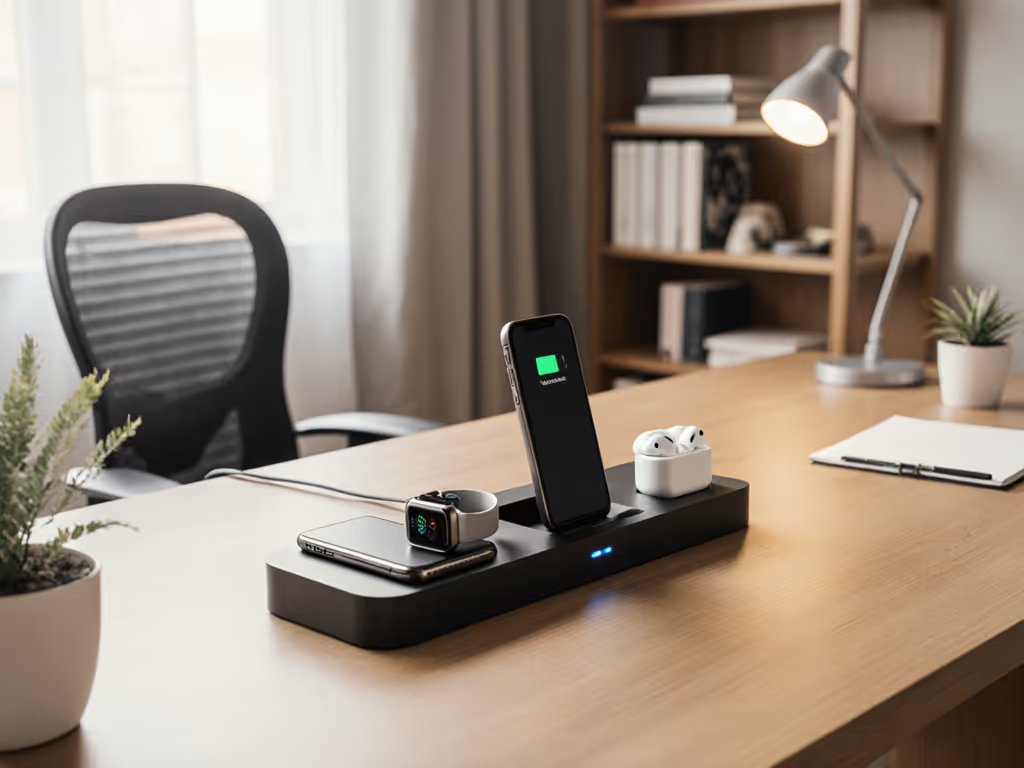
MagFusion Ark Review: Modular Wireless Charger Tested
By Luca Moretti • 23rd Feb
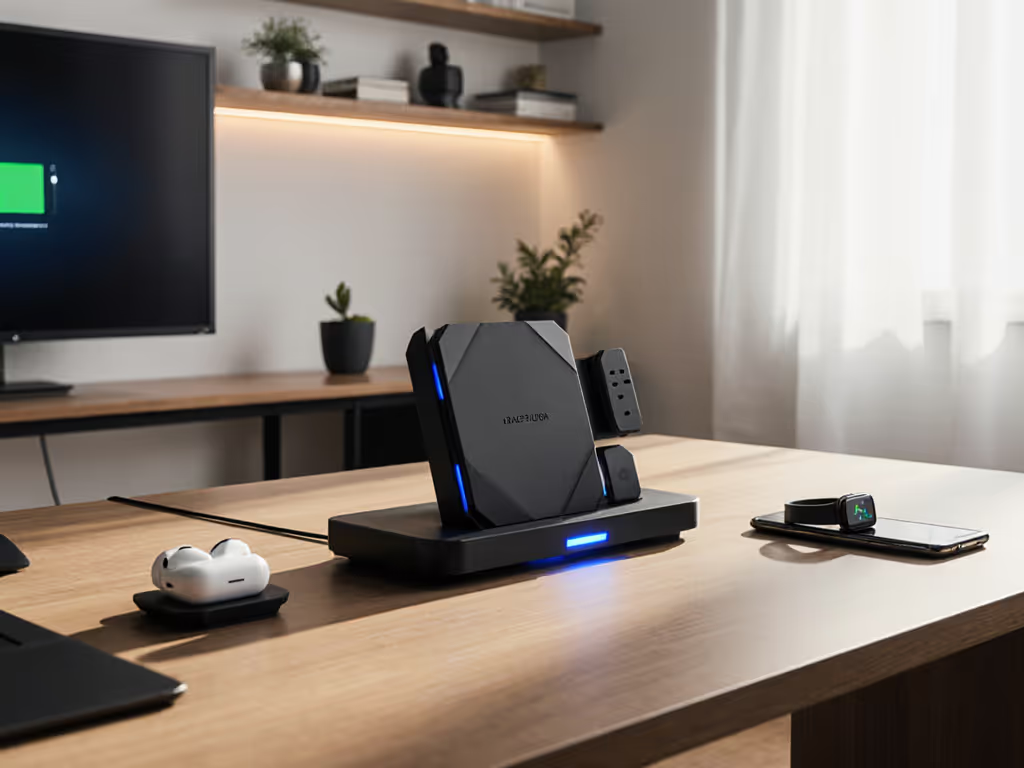
The Problem: Charging Chaos Meets Decision Paralysis
In my first apartment, one outlet fed everything near the couch. Cables snarled, adapters vanished, and friends teased my 'charging scavenger hunt.' That was years ago, yet the core frustration hasn't changed: most households still don't have a coherent charging system. Instead, they have a drawer full of half-working pads, proprietary watch pucks, and a nagging fear that slower wireless charging is somehow secretly degrading battery health.
Today's pain points are sharper. You've got mixed-device households (iPhones, Pixels, Galaxies, AirPods, watches, and tablets) all demanding juice simultaneously. Wireless charging works, but it's fragmented: Qi2 just went mainstream, Apple's MagSafe 2 is hitting 25W, and older 5W/7.5W pads suddenly feel like tech debt. You face decision overload: conflicting advice on what's actually certified, concerns about heat, fear of wasted cash on a standard that'll be obsolete in two years, and the honest truth that most 'multi-device chargers' are just stacked pads that half-work. If you're comparing household pads and hubs, our multi-device wireless charging guide shows which designs actually work with multiple phones and earbuds at once.
The real agitation? You want one investment that doesn't require a thermal camera, a certification checklist, and a spreadsheet of sustained-watt-per-dollar math. You want it to handle a household, look clean, run cool, and not vanish in the next upgrade cycle.
The MagFusion Ark: A Modular Answer to Ecosystem Chaos
Aukey unveiled the MagFusion Ark at IFA 2025, and the claim alone caught my attention: 'the world's first modular true wireless charger.' That's bold. Let's unpack what that actually means, and whether the spec sheet translates to real-world value.
Architecture and Core Design
The MagFusion Ark review starts with the chassis: a base station housing three wireless charging pads, topped with three detachable spheres (each a 6,700mAh power bank in its own right). This 6-in-1 design is modular: the spheres snap onto the base to recharge, or detach and function as standalone portable chargers. When docked, each sphere recharges while simultaneously charging a device placed on top of it. That dual-direction capability is the 'true' part of the claim, and Aukey calls it Rx-Tx technology (receive and transmit simultaneously), distinguishing it from conventional chargers that only transmit power.
In practice: the base charges three devices directly. Add the three spheres, and you've got six charging points. Tether one sphere to charge your phone, use another as a bedside portable, dock a third to top up earbuds. The architecture solves the 'not enough pads' problem elegantly.
Qi2.2 Certification and Real Wattage
Here's where certification matters. Every charging point (base and spheres) is built on the Qi2.2 wireless charging standard, delivering up to 25W per pad. For context: Qi2 is the newest standard supporting magnetic attachment and speeds up to 25W, a hard jump from Qi's old 15W ceiling. Critically, all six points hit 25W Qi2.2 simultaneously, not a combined 25W split across multiple devices (a common marketing deception).
With the iPhone 16 and upcoming iOS 26, devices will support this 25W standard natively. For Android, Samsung Galaxy models and Google Pixel phones also align with Qi2.2. That broad compatibility is Aukey's hedge against ecosystem fragmentation. See our Qi2 25W thermal throttling tests for sustained power data across popular chargers. Your friends' phones, your partner's tablet, your kid's Nintendo Switch (if it supports wireless charging) all speak the same language.
Value shows up in watts delivered per hard-earned dollar. Qi2.2 certification at 25W per pad across six points means you're not buying into beta-standard risk or compatibility guesswork. The standard is live. Devices are shipping. No wait-and-see.
Active Cooling and Thermal Reality
One of the most underrated specs: active cooling. Each detachable sphere features an integrated active cooling system to prevent overheating and protect battery health. That matters because sustained 25W wireless charging, especially when six pads run simultaneously, generates heat. Thermal anxiety is real: users worry that fast wireless charging accelerates battery degradation. For the physics and best practices, read our wireless heat & safety explainer. Aukey's cooling system is designed to blunt that concern.
I can't drop the Ark into a thermal chamber here, but the emphasis on active cooling tells me the engineering team didn't just chase wattage numbers. They built in a heat mitigation strategy. For extended nightstand or desk use, that's the difference between a charger that runs warm and one that runs cool.
USB-C and Bidirectional Charging
Each sphere packs a USB-C port supporting PD 3.0 at 30W, enabling bidirectional charging. Practically: you can charge the sphere itself over USB-C, or plug a cable into the sphere to charge a device. This flexibility dissolves one legacy frustration (the 'wrong charger in the wrong room' problem). A single USB-C brick can feed the base (to recharge the spheres), or charge the sphere directly, or charge a phone via the sphere's USB port if wireless feels too slow.
30W over USB-C is robust. It means charging a phone and earbuds simultaneously via one sphere: wireless pad for the phone, USB-C port for the earbuds. Or charging two phones in sequence faster than traditional multi-device pads.
Magnetic Stand and Utility Features
Each sphere doubles as a magnetic stand for hands-free viewing, handy for FaceTime, video watching, or StandBy mode on iPhones. It's not revolutionary, but in a multi-device household, it adds utility without clutter. A charging pad that also holds your phone at a useful angle is one fewer dock you need to buy.
Real-World Use Cases: Does It Solve the Pain?
The Multi-Person Household
Aukey markets the Ark as ideal for households, shared living spaces, and office environments. That's accurate. Picture a family of four: two iPhones, one Pixel, one Samsung tablet, two AirPods cases, and an Apple Watch. Traditional setups force compromises, like plug in the watch here, stack two phones there, earbuds nowhere. The Ark's six-point design means everyone charges simultaneously without compromise. Active cooling keeps thermal stress low even when all six pads run at full capacity.
The Desk and Nightstand
For remote workers or night-table users, the modular design shines. Keep two spheres docked on your nightstand (one as your phone pad, one as an earbud charger), and carry the third sphere to the office for daytime use. You get versatility without duplicating hardware. The magnetic stand feature supports the 'Always-On' display trend on modern flagships. Your phone charges while displaying a clock or photos without sliding around.
Travel and Portability
Each detached sphere is a portable 6,700mAh power bank. That's modest by modern standards, not enough to fully charge a modern flagship twice, but paired with the 30W USB-C port, it's practical for day-trip scenarios. Grab one sphere, a USB-C cable, and you've got both wireless and wired charging in your pocket. No separate power bank purchase required.
Price-to-Performance and Hidden Costs
MSRP and Street Pricing
Aukey has not yet published final US/EU MSRP as of February 2026 (the Ark debuted at IFA in September 2025 and is still ramping availability). Early estimates from coverage suggest positioning in the $150-$200 USD range, though confirmation is pending. For comparison:
- Apple's single MagSafe 2 puck: ~$35-$45
- Anker's multi-device Qi2 chargers: $80-$130
- Premium docking systems (Belkin, Nomad): $100-$200
The Ark's modular design and Rx-Tx capability aren't commodities, so a mid-tier premium is justified. The key question: are you paying for real utility or hype?
Cost per Sustained Watt and Efficiency
Here's the Luca calculus: six charging points at 25W each equals potential 150W total, but that's peak. Sustained watt output depends on the power brick feeding the base. Aukey hasn't yet published the required input wattage; I'd expect a 65-90W PD brick to handle simultaneous charging without throttling. That brick typically costs $30-$50 separately.
If the Ark retails at $180 with a required $40 power brick ($220 all-in) and delivers six reliable 25W pads, you're paying roughly $37 per charging point. A standalone Qi2 pad costs $30-$60 each; buying six would be $180-$360. The Ark's modularity and unified ecosystem trim that to one purchase. Not cheap, but rational.
Warranty and Return Policy
Warranty details aren't yet public; Aukey typically offers 1-2 year limited warranties on chargers. Return policy varies by retailer. This matters because you're betting on Qi2.2 adoption. If your devices don't match the standard faster than expected, return flexibility matters.
The Hidden Cost: Standards Evolution Risk
Skip the hype tax, but don't skip this: Qi2.2 is new. Adoption is broadening, but it's not guaranteed to be the final word. Qi3 or a proprietary magnetic standard could emerge in 3-4 years. You're buying into a six-month-old standard, not a decade-old one. That's acceptable risk if the Ark future-proofs you, and Qi2.2's broad device support suggests it will, but it's not zero risk.
Certification, Safety, and Trust
Qi2.2 certification is administered by the Wireless Power Consortium. Learn how to verify genuine compliance with our Qi2 certification guide. Aukey's claims of Qi2.2 compliance are significant; if they hold, you're not gambling on safety margins. Certified chargers have passed thermal, alignment, and power-delivery testing. You're not buying on faith.
Active cooling is a trust signal too. Cheap multi-device pads often lack thermal management, running warm and degrading batteries over time. Aukey's cooling system suggests they designed for longevity, not just first-year performance.
Verdict: Is the MagFusion Ark Worth It?
Who It's For
Yes, if you: (1) live in a multi-device, multi-person household; (2) work remotely or spend long hours at a desk; (3) want Qi2.2 performance today without waiting for Apple or Samsung to bundle chargers; (4) value a clean, unified charging aesthetic over a stack of mismatched pads; (5) are willing to buy one modular system instead of six separate pads.
No, if you: (1) use only one device and don't need portability; (2) already own a working Qi charger ecosystem; (3) demand the absolute lowest price per charging point; (4) distrust new wireless standards.
Real-World Outcome
The MagFusion Ark solves three genuine friction points: ecosystem fragmentation (one system, six devices), modular flexibility (detach spheres, travel light), and thermal anxiety (active cooling for sustained charging). It's not cheap, and it carries minor standards-evolution risk. But for tech-forward households managing mixed platforms, it checks boxes that six separate pads don't.
The certification is legit. The Rx-Tx architecture is novel. The sustained 25W at all six points is genuinely useful. At a projected $180-$220 all-in (including the required power brick), it lands in the premium-but-rational tier, not the hype tier.
Final verdict: Yes, the MagFusion Ark delivers real value for multi-device households willing to invest in modularity and active cooling. Smart spending means buying the right wattage once, and the Ark's Qi2.2 alignment and future-proofed design live up to that principle. Just confirm final MSRP, warranty terms, and power-brick specs before checkout.
Related Articles