RF Energy Harvesting for IoT: Battery-Free Power for Smart Homes
By Asha Raman • 25th May

RF energy harvesting for IoT promises battery-free sensor networks and truly ambient wireless power smart home devices, but only for very low-power use cases, and only when we respect the physics rather than the hype.
As someone who spends a lot of time studying how power delivery affects device health, I see RF harvesting as a complementary layer: ideal for tiny, often-forgotten nodes where coin-cell replacement is the real pain point, not for phones or laptops that must stay cool and responsive under heavier loads.
Health-first beats hype.
In this FAQ deep dive, I will unpack what RF energy harvesting can realistically do in smart homes, how it works, where it fits alongside Qi/Qi2 and wired power, and what to watch as the ecosystem matures. For a broader overview of ambient power sources beyond RF, see our energy harvesting primer.
What is RF energy harvesting, in plain terms?
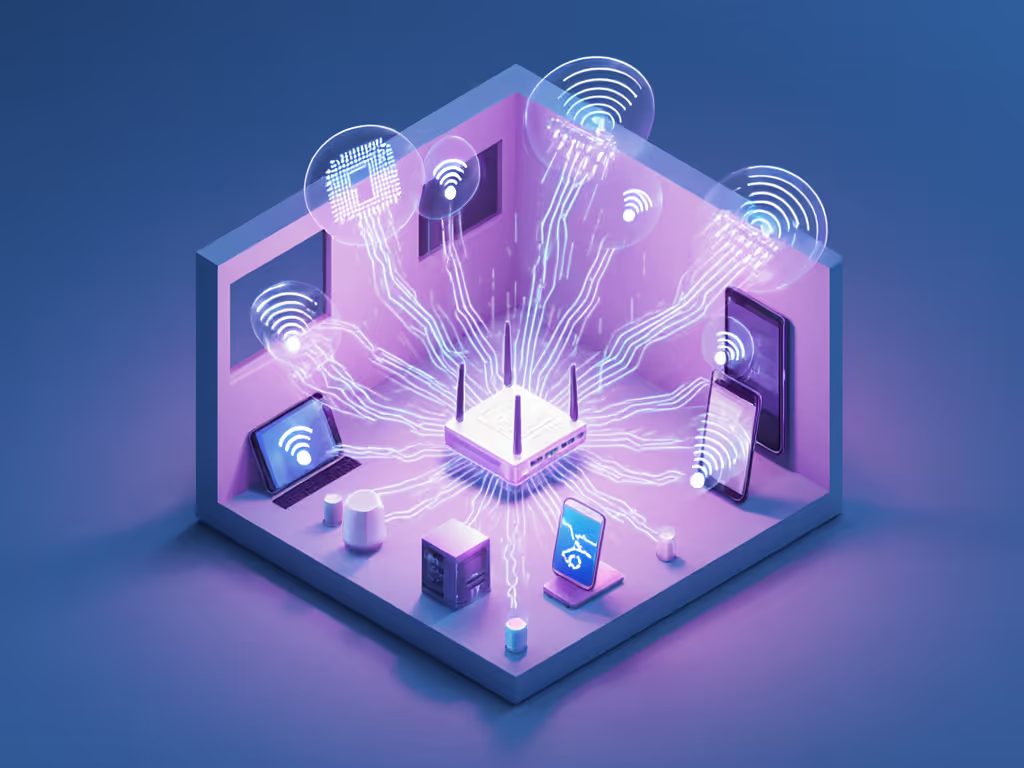
RF energy harvesting (RFEH) is the process of capturing small amounts of energy from ambient radio-frequency electromagnetic waves, such as Wi-Fi, cellular, and broadcast TV signals, and converting them into usable DC power.
Typical ambient RF sources in and around a home include:
- Wi-Fi access points (2.4 GHz, 5 GHz, 6 GHz)
- Bluetooth devices
- Cellular base stations (macro and small cells)
- Broadcast TV and radio towers
A harvesting system uses:
- An antenna to capture RF energy
- Impedance matching circuitry so the antenna and rectifier exchange power efficiently
- A rectifier (often a diode-based or CMOS rectifier) to convert RF AC into DC
- Optionally, a voltage multiplier to boost voltage from weak inputs
- Energy storage (supercapacitor or small battery) and power management to feed the load
The goal is a self-sustaining node that draws its operating energy from the RF environment, potentially eliminating the battery entirely for ultra-low-power devices.
How much power is realistically available in a home?
In most residential environments, the available RF power is extremely low, typically in the microwatt (µW) to low milliwatt (mW) range at the harvester, depending on distance and line-of-sight to transmitters.
Key points:
- Ambient Wi-Fi, Bluetooth, and cellular fields in a home generally support micro- to milliwatt-level harvesters, not watt-level loads.
- RF harvesting circuits must operate efficiently at very low input power, often with received power below −10 dBm (0.1 mW).
- Research focuses on high-efficiency rectifiers and matching networks precisely because every fraction of a dB matters at these levels.
This is enough for intermittent sensing and short radio bursts, not for continuous high-power operation.
What kinds of smart home devices can be battery-free?
Given those power limits, zero-power smart home devices are currently limited to applications where the average power budget is extremely small and duty-cycled.
Analyst and industry reports highlight several high-potential categories for battery-free sensor networks:
- Electronic shelf labels and e-paper displays (e.g., inventory and price tags)
- Environmental sensors: temperature, humidity, air quality, leak detection
- Beacons and presence sensors for room occupancy or asset location
- Low-duty-cycle trigger devices (e.g., event markers, simple switches)
- Loss-prevention and goods location monitoring (tags that signal only occasionally)
Forecasts suggest that by 2030, around 3 billion IoT devices could potentially be powered by RF energy harvesting, roughly one tenth of all connected IoT devices. Building automation and tracking/monitoring applications, many of which overlap with smart-home-style sensing, are prominent within this forecast.
For a smart home, this translates into scenarios like:
- Contact or vibration sensors on windows and doors that never need battery changes
- Tiny tags that report the presence of keys, remotes, or tools in specific zones
- Distributed temperature/CO2 nodes in a home office or nursery
In practice, many early deployments pair RF harvesting with small energy storage elements rather than being strictly "battery-free"; the harvested RF lightens or eliminates the need for battery replacements.
Can RF energy harvesting replace phone chargers or Qi/MagSafe?
No. RF energy harvesting cannot realistically replace wired, Qi, Qi2, or MagSafe charging for phones, tablets, or laptops. The gap in available power is several orders of magnitude.
To keep a modern smartphone charged while in use, you typically need several watts of power. Ambient RF harvesting in a home is, at best, delivering microwatts to low milliwatts per node. Even dedicated RF transmitters designed for power delivery must respect regulatory limits on radiated power, which still constrain them far below practical fast-charging levels.
From a battery-health standpoint, this is a blessing in disguise. Any attempt to push more RF power into a room to "charge phones through the air" would need to:
- Respect exposure regulations
- Deal with inefficient conversion, which turns precious power into heat inside the device's power front-end
And as I learned from a poorly designed wireless car mount on a hot day, once device temperatures climb past the low-40s C, navigation stutters and batteries show their discomfort long before users do. Protect the pack, and performance naturally lasts the distance.
So for phones and laptops, RF energy harvesting is not a viable primary charger. It is a niche power source for ultra-low-power nodes, not a competitor to MagSafe or Qi2 stands. If you're choosing daily phone or laptop charging, see our wireless vs wired charging comparison for practical trade-offs.
How does an RF energy harvesting system work, end to end?
A typical RF energy harvesting for IoT node has the following architecture:
- Antenna – tuned to relevant frequency bands (e.g., 900 MHz, 2.4 GHz) to capture incoming RF energy.
- Impedance Matching Network (IMN) – maximizes power transfer from antenna to rectifier, minimizing reflections and losses, which is crucial at low input powers.
- Rectifier / Voltage Multiplier – converts RF AC to DC, sometimes stacking multiple stages (Dickson or Cockcroft-Walton topologies) to raise voltage at the cost of current and added losses.
- Energy Storage – usually a supercapacitor or a small rechargeable battery to buffer intermittent energy and provide bursts for radio transmissions.
- Power Management Unit (PMU) – includes maximum power point tracking (MPPT)-like logic, under-voltage lockout, and regulation to keep the microcontroller and radio within safe operating ranges.
- Ultra-low-power MCU + Radio – often running optimized protocols and duty cycles (e.g., very short BLE advertisements, or proprietary low-duty-cycle schemes) to stay within the tight energy budget.
Research efforts largely target improving rectifier efficiency, lowering the cold-start voltage of PMUs, and co-designing the network and node behavior so that both energy and data flows are optimized.
What are the main technical challenges in ambient wireless power smart homes?
Turning the idea of ambient wireless power smart home systems into reliable reality faces several engineering challenges:
- Distance and fading – RF power density drops with distance and can be blocked or reflected by walls, furniture, and people.
- Very low input power – rectifier and PMU circuits must operate efficiently even when harvested power is below 100 µW.
- Variable RF environment – router settings, occupancy, and neighboring networks change the RF landscape over time; nodes must adapt their duty cycles accordingly.
- Network-aware design – higher-layer protocols need to account for energy availability, scheduling transmissions when enough energy is stored.
- Standardization and interoperability – today's RF harvesting deployments are mostly vendor-specific (e.g., using proprietary beacons or dedicated transmitters).
Because of this, RF-harvested IoT in homes will likely begin in very controlled niches (retail displays, enterprise buildings, logistics, and specific sensor zones) before becoming truly ubiquitous in consumer-grade smart-home kits. For room-scale power that reaches across meters, compare technologies in our far-field wireless charging guide.
How mature is the ecosystem? Any real deployments?
RF energy harvesting is already commercially deployed in several IoT segments, though primarily in enterprise and industrial contexts rather than mainstream consumer smart homes.
- Industry analyses describe RF-powered electronic shelf labels, environmental monitors, and tracking tags that operate without batteries or with dramatically extended lifetimes.
- Solution providers such as those compared in market research (e.g., Powercast, Wiliot) offer platforms combining dedicated RF transmitters with ultra-low-power tags.
Transforma Insights estimates that up to 3 billion IoT devices could leverage RF energy harvesting by 2030, with inventory and stock-level monitoring alone representing more than half of that opportunity.
For a homeowner or small-office manager, this means:
- You will increasingly encounter invisible, maintenance-free sensors baked into infrastructure (HVAC systems, office furniture, shelving) rather than buying them individually.
- Some "no-battery" smart-home accessories may quietly rely on RF harvesting in the background, even if the packaging emphasizes the application rather than the power source.
Is RF energy harvesting safe in the home?
From a safety perspective, RF-harvested IoT nodes simply recycle energy that is already present in the environment from Wi-Fi, cellular, and broadcast systems. The nodes themselves do not add RF exposure; they only receive.
When dedicated RF power transmitters are used (for example, in a room-scale deployment), they must still conform to regulatory limits on radiated power and exposure, such as those enforced by regional spectrum regulators. Commercial solutions are designed around these constraints.
For device health:
- Harvested power levels are so low that they do not add thermal stress to nearby devices.
- The primary thermal consideration remains your main chargers and power electronics, not the harvester tags.
In other words, RF harvesting is not a new thermal threat to your devices; if anything, it offers a path to fewer heat-generating charge cycles for certain battery-powered sensors.
How does RF energy harvesting interact with battery longevity?
Even when nodes are not fully battery-free, RF harvesting can improve battery longevity by reducing the depth and frequency of discharge cycles.
Hybrid designs might:
- Use a tiny rechargeable cell as a buffer while RF provides the everyday energy budget
- Delegate peak loads (e.g., longer firmware updates) to wired or higher-power wireless chargers
From a longevity standpoint, this is attractive because:
- Shallower cycles generally reduce mechanical and chemical stress within lithium-ion and lithium-polymer cells.
- Fewer high-current charge cycles mean less heat, which is strongly correlated with faster capacity fade.
My bias is consistent across Qi, Qi2, MagSafe, and RF-powered systems: keeping average cell temperature below the low-40s C range is one of the most practical levers you have for long-term health. In that sense, RF harvesting is aligned with the principle that Health-first beats hype.
How can I practically plan for RF-powered, zero-maintenance devices?
If you are designing or curating a smart-home ecosystem today, RF energy harvesting is more about future-proof awareness than immediate shopping lists.
Practical steps:
- Prioritize maintenance-free zones – in places where battery changes are annoying (high ceilings, tight panels, outdoor gates), favor devices advertised as energy-harvesting or "no-battery" when credible.
- Pay attention to RF infrastructure – robust Wi-Fi coverage and carefully placed access points are prerequisites for both data and potential RF power density.
- Consider hybrid models – devices that combine energy scavenging technology with long-life cells can strike a balance between reliability and reduced maintenance.
- Ask for transparent specs – look for vendors that specify average power budgets, duty cycles, and expected lifetime, rather than vague "self-powered" claims.
For engineers and technically inclined readers, development kits for RF harvesting can be a valuable way to measure real-world harvested power in your own environment and calibrate expectations. Even a simple lab exercise (plotting harvested voltage vs. distance from a router) builds intuition faster than any marketing sheet. For smart-home use cases and setup tips, explore wireless power for battery-free smart homes.
From there, you can design your broader charging ecosystem so that high-power devices use efficient, cool-running wired or Qi2/MagSafe chargers, while low-power sensors increasingly rely on RF harvesting and other scavenged sources. Protect the pack, and performance naturally lasts the distance.
If this space aligns with your desire for calm, low-maintenance smart homes, the next step is to keep an eye on:
- Enterprise deployments of RF-powered ESLs and building sensors
- Emerging standards and interoperability efforts in low-power IoT
- Research on network-aware RF energy harvesting and system co-design
Ambient RF will not replace your nightstand charger, but it may quietly power the sensors that make your home feel intelligent without ever asking you for a battery change.
Related Articles