NFC vs Qi Wireless Charging For Wearables: Which Is Better?
By Luca Moretti • 17th May
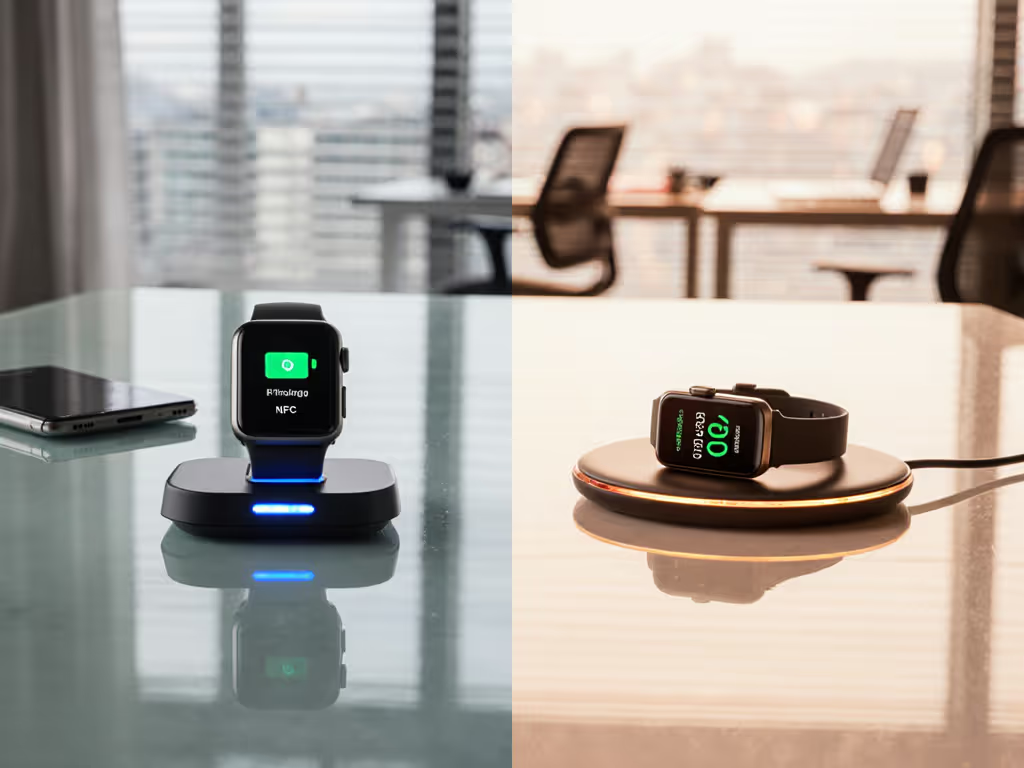
When you dig into NFC vs Qi wireless charging for wearables, you quickly realize this is a very different problem than charging a phone. Coils get tiny, thermals get tricky, batteries are small, and one bad design choice can turn an elegant ring or band into a fussy, slow-charging diva. This wearable wireless charging comparison will keep us strictly focused on price-to-performance, actual watts, and long-term ownership, not shiny renders.
Pay for watts, not for wallpaper.
1. NFC vs Qi: The Short Version For Wearables
If you only remember one thing:
- Qi is a high-power, larger-coil standard, engineered primarily for phones and tablets and adapted downward for some wearables.
- NFC Wireless Charging (WLC) is a low-power, tiny-antenna system built on top of NFC, great where space is brutal and data matters more than raw watts.
For wearables, the trade-offs look like this:
| Factor | Qi (for wearables) | NFC Wireless Charging (WLC) |
|---|---|---|
| Typical usable power in wearables | ~2-5 W | Up to 1 W (often ~0.25-0.5 W) |
| Operating frequency | ~100-205 kHz | 13.56 MHz |
| Coil / antenna size | Needs wider, thicker coil | Very small antenna possible (ring, sensor) |
| Alignment sensitivity | High (sweet spot is small) | More tolerant of orientation |
| Data transfer | Minimal control channel only | Full NFC data (pairing, firmware, auth, logs) |
| Best for | Watches, larger bands, earbuds cases | Rings, tiny sensors, sealed medical/industrial devices |
| Ecosystem maturity | Very mature; Qi logos, lots of pads | Emerging; few consumer chargers |
For phones, Qi wins by default. For wearables, it depends heavily on form factor and battery size. For a deeper technical look at NFC's low-watt profile for tiny wearables, see our NFC charging for rings.
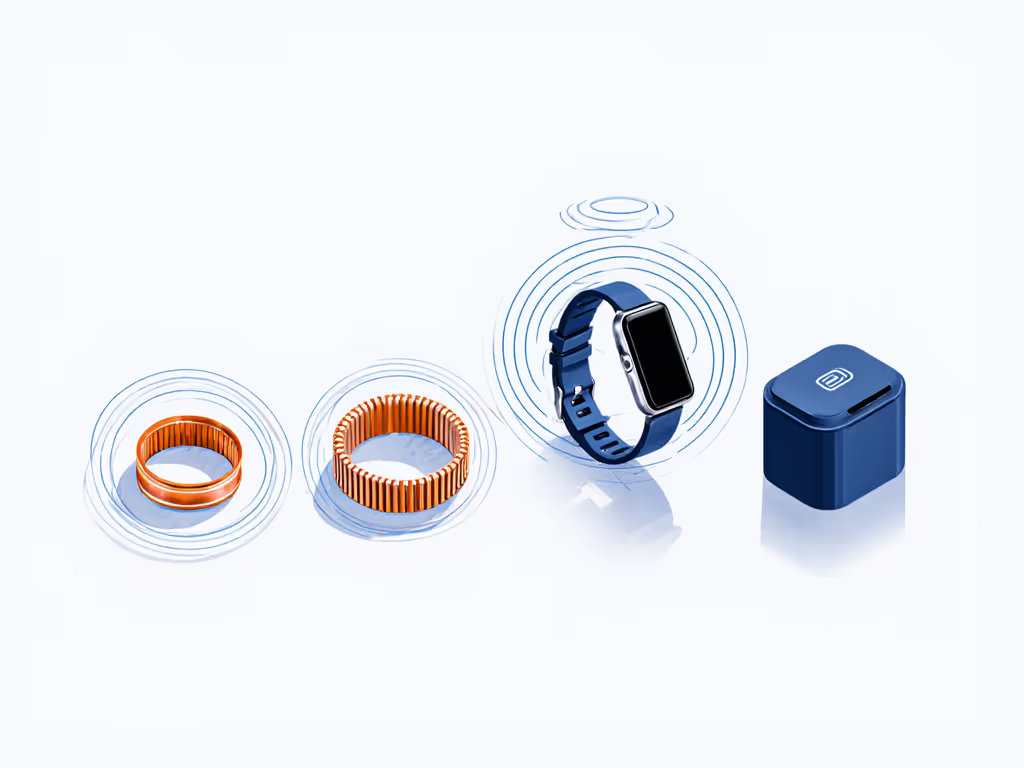
2. What Changes When The Device Is On Your Body?
Phones live on desks and dashboards. Wearables live on skin, under clothing, in pockets, and in tight jewelry tolerances. That changes everything: thermal limits, coil geometry, and even skin comfort.
2.1 Power needs and nfc wearables power efficiency
Typical ballpark battery capacities (just to frame the discussion):
- Smartwatch: 250–500 mAh
- Fitness band: 100–200 mAh
- Smart ring: 15–25 mAh
- Tiny sensor (patch / tag): 5–30 mAh
With wearables, you rarely need phone-level charging speeds. A lot of users are fine with:
- Smartwatch: 1–2 hours from near empty to full
- Ring / sensor: 30–60 minutes top-up while you shower or work
That makes efficiency at low power more important than peak numbers:
- Qi hardware is very good at higher power. At 2-5 W it can still be efficient, but small coils can reduce efficiency, so heat rises.
- NFC WLC is designed around sub-1 W delivery. It can be surprisingly efficient in that envelope, and because it shares the NFC antenna, there are layout and BOM cost wins too.
From a pure engineering standpoint, nfc wearables power efficiency can be excellent for small devices that trickle charge but never need a 15 W firehose.
2.2 Size and shape: where qi charging limitations for small devices show up
Qi's physics favor larger, flatter coils:
- Works great for: phones on stands, flat watch pucks, earbuds cases with enough footprint.
- Struggles for: curved surfaces, ultra-narrow bands, and tiny jewelry.
You see Qi charging limitations for small devices in three places: For ring-specific trade-offs and charger picks, check our smart ring charging guide.
- Coil doesn't fit: A compliant Qi coil can simply be too big to fit a thin ring or minimalistic band.
- Alignment is fussy: On a watch or small band, the active area is tiny. Shift a few millimeters and you drop from 3 W to an unreliable trickle.
- Thermals near skin: At small scales, a few extra tenths of a watt of loss gets noticeable as warmth on skin or metal.
NFC WLC, by contrast, rides on a 13.56 MHz antenna that can be very compact and doesn't demand such tight mechanical alignment. That's why it's being explored aggressively for contactless charging for rings, earbuds-like pods, and sealed medical sensors.
3. Wearable Wireless Charging Comparison By Form Factor
Let's drop the marketing and look at wearable charging performance metrics, power, alignment, cost, and long-term ownership, across the main categories.
3.1 Smartwatches and mainstream fitness bands
Think Apple Watch, Galaxy Watch, Pixel Watch, Garmin, Fitbit.
Reality check: most today are not pure Qi or pure NFC WLC, they use proprietary inductive systems, often Qi-like but tweaked for size and thermals.
Where Qi-style shines here:
- Power envelope: 2-5 W is easy, which enables:
- 0-80% in ~45-60 minutes on many mainstream watches
- Ecosystem: Car mounts, desk stands, 3-in-1 chargers often embed Qi-style watch coils.
- Cost per sustained watt: A decent third-party puck at 3 W for, say, 25 USD comes out near 8-9 USD per sustained watt, which isn't bad for a niche accessory.
Where it bites you:
- Alignment sensitivity, nudged off-center on a nightstand and you wake to a half-charged watch.
- Heat, metal cases and tight packaging mean the difference between 2 W and 4 W can be the difference between cool and toasty on your nightstand.
Verdict for watches and larger bands
- If you're a product designer: a Qi-derived solution (or full Qi if you can fit the coil) is usually the best trade-off. You get enough power to support fast top-ups and a nicer UX.
- If you're a buyer: pick watch chargers that clearly advertise Qi certification or MFi/brand certification, and avoid generic no-name pucks with vague 10 W claims, your watch will never use that, and the losses become heat.
Value shows up in watts delivered per hard-earned dollar.
Spending 30 USD on a puck that reliably delivers 3 W without overheating beats a 15 USD no-name that promises 15 W and actually delivers 1.5 W and a warm case.
3.2 Rings and ultra-small wearables: where NFC WLC matters
Smart rings are the perfect stress test: tiny circumference, tight mechanical tolerances, and very small batteries. This is where contactless charging for rings runs straight into the limits of classic Qi.
Take the OURA Ring Gen3, a leading health-tracking ring with a very small internal volume and 5–7 days of battery life. It uses a compact dock and short charging sessions to refill a tiny battery while keeping the outer form elegant.
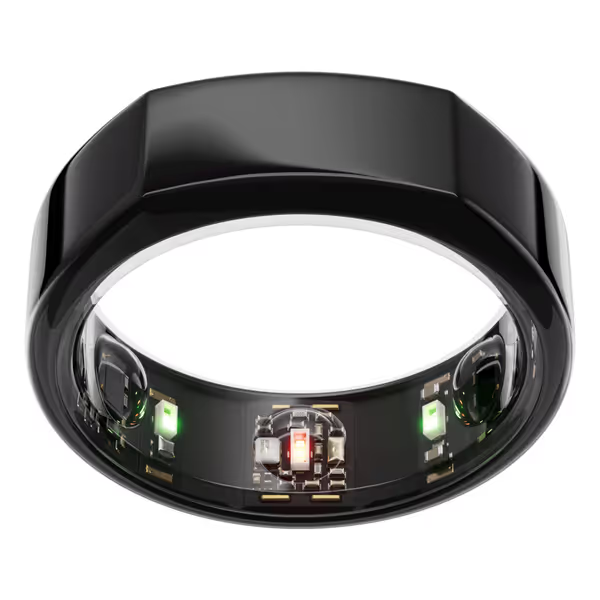
OURA Ring Gen3 Heritage - Black
Revolutionary smart ring for accurate health tracking and personalized insights.
$349
Battery Life5-7 Days
Battery Life5-7 Days
Pros
Research-grade sensor accuracy for biometrics
Integrates with 40+ popular health apps
HSA/FSA eligible for health savings
Cons
Subscription required after first month
Potential inaccuracies in step/sleep count for some users
Customers generally find the ring to be accurate for tracking sleep and heart rate, with some noting its ability to detect naps and stress. However, one user reported inaccuracies with step counting and sleep tracking compared to other devices.
Customers generally find the ring to be accurate for tracking sleep and heart rate, with some noting its ability to detect naps and stress. However, one user reported inaccuracies with step counting and sleep tracking compared to other devices.
Important point: the Oura solution is not branded as Qi or NFC WLC; it's a proprietary low-power inductive system. But the trade-offs it solves are exactly what NFC WLC is built for:
- Very small antenna / coil embedded in a curved metal or ceramic shell.
- Power budget closer to fractions of a watt than to 5–10 W.
- Tight thermal headroom (users wear it day and night; even mild heating during or after charge is undesirable).
For devices like this, NFC WLC offers:
- Shared antenna: one hardware element can handle both data and power.
- Data during charge: ring could sync health data, firmware updates, or personalization while sitting on the dock.
- Loose orientation: ring doesn't need to hit a postage-stamp-sized sweet spot to start charging.
From a price-to-performance view:
- The silicon cost for NFC WLC can be low if the device already needs NFC for identity or secure communication.
- You save on mechanical complexity by not needing an additional Qi-sized coil.
For consumers evaluating smart rings and tiny trackers:
- Don't fixate on whether the spec sheet says Qi or NFC.
- Look instead at:
- Time to full charge from typical daily usage
- Dock alignment forgiveness (do you need to fiddle with it?)
- Reported warmth on user reviews
Rings that top up in 30–60 minutes, stay cool, and don't require pixel-perfect placement are doing the physics right, regardless of logo. That's what matters day to day.
3.3 Earbuds and compact cases
Earbuds are an in-between category:
- Cases are just big enough to embed a Qi coil (and many already do).
- Batteries inside the case are typically 300-500 mAh, like a small wearable.
Here, Qi remains the better overall choice:
- Power: 2–3 W is plenty to refill a case and buds between uses.
- UX: users are trained to toss the case onto any Qi pad.
- Cost: coil + controller is moderately priced in volume.
NFC WLC could theoretically be used for ultra-small cases, but there's little consumer benefit vs the existing Qi ecosystem, unless you need tight integration with NFC payments or security.
3.4 Medical and industrial sensors
Patch sensors, asset tags, sealed modules on equipment, here NFC WLC often wins outright: For safety standards and design considerations in clinical wearables, see medical wireless charging safety.
- Devices may be hermetically sealed; no port, no exposed metal.
- Power demands are tiny (they wake up, sample, transmit, then sleep).
- Service technicians want simple alignment and data + power in one tap.
An NFC WLC cradle can:
- Deliver a safe trickle (say 0.25-0.5 W)
- Simultaneously pull logs and push configuration
- Reuse the exact same antenna used for on-site NFC scanning
Qi in these situations is often overkill and physically harder to fit.
4. Key Performance Metrics That Actually Matter
Marketing likes to throw out headline wattage. For wearables, those numbers are often irrelevant. Instead, scrutinize these wearable charging performance metrics:
4.1 Sustained, real-world power
A watch advertised for 5 W wireless charging might actually average 2-3 W in practice due to thermal throttling and alignment drift.
Ask or test:
- How long does it take to go from 20% to 80%?
- Does the device get noticeably warm against your skin afterwards?
For rings and tiny trackers, even 0.5-1 W sustained is respectable. More than that can actually be a red flag for heat.
4.2 Thermal behavior
Because these devices live on your body:
- Favor solutions that stay under mildly warm to the touch during a normal charge.
- Be wary of chargers that heat nearby metal cards, keys, or jewelry (a risk more associated with misdesigned Qi coils).
NFC WLC's low power ceiling is a safety advantage here: it's physically hard to get it dangerously hot when correctly designed.
4.3 Alignment tolerance and daily friction
Misalignment is where many Qi-based wearables fail UX tests:
- If you can drop the device roughly onto the dock in low light and hear/feel an immediate confirmation, you're good.
- If you frequently wake to 10% battery because the watch sat a few millimeters off-center, that's money and time wasted.
NFC WLC tends to be more forgiving on orientation for tiny devices, but only if the dock is designed thoughtfully.
4.4 Certification, warranty, and long-term cost
With wireless power, certification logos are one of the few hard signals you have:
- On Qi chargers: look for official Qi certification from the Wireless Power Consortium. If you sell or deploy across regions, our global wireless charging regulations guide explains FCC, CE, and other marks and how to verify them.
- For NFC-based systems: look for NFC Forum compliance and the usual safety marks (FCC, CE, UL/ETL where applicable).
Then check the boring but crucial parts:
- Warranty length for the charger and the wearable
- Return policy (especially for rings and custom-fit devices where sizing and comfort are variable)
MSRP vs street price, plus these policies, determine your true cost of ownership.
For example, the OURA Ring Gen3 currently lists around 349 USD at major retailers. That's a premium ticket, but it includes:
- The ring itself with research-grade sensors
- A compact charger in the box
- A mature app and ecosystem
If that device delivers 5-7 days of battery life and charges reliably in short sessions while you shower or work, its cost per year of usage is often lower than a cheaper, less accurate tracker you churn through every 12–18 months.
Remember: Value shows up in watts delivered per hard-earned dollar, and in how many years you get to enjoy those watts without hassle.
5. NFC vs Qi For Wearables: Decision Matrix
Here's the practical summary, whether you're choosing a product to buy or sketching a new design.
5.1 If you are a buyer (consumer or IT purchaser)
Use this quick rule-of-thumb:
-
Smartwatches / mainstream bands
- Prefer: Brand-certified or Qi-certified chargers.
- Avoid: Generic high-wattage pucks with no clear certification.
- Check: Real 20-80% charge time and temperature on reviews.
-
Smart rings and ultra-small trackers
- Expect: Proprietary or NFC-style low-power inductive systems.
- Prioritize:
- Comfortable, easy-to-hit dock design
- Short, predictable charge windows
- Strong reviews around reliability and comfort (no heat complaints)
-
Earbuds cases
- Prefer: Qi support for convenience on shared household pads.
- Check: Case footprint and coil location to avoid alignment drama.
-
Medical / industrial wearables
- Look for: NFC-based or proprietary low-power inductive solutions with strong safety and compliance documentation.
- Make sure: Charging cradles are robust, keyed, and idiot-proof for staff.
5.2 If you are a product designer
Here's the more engineering-centric decision path:
-
Is your battery > 300 mAh and your device at least ~3 cm across?
- Most likely answer: Qi or Qi-derived inductive power is appropriate.
-
Is your device smaller (ring, tag, patch) with < 100 mAh and you already need NFC?
- Strong candidate: NFC WLC, reusing the NFC antenna for both power and data.
-
Do you need high-data-rate communication during charge (e.g., firmware, logs)?
- NFC makes this easy; Qi will need separate radios.
-
Is skin contact continuous or prolonged during or immediately after charge?
- Stay in the sub-1 W regime or design the UX around taking the device off-body to charge.
-
What's your cost per sustained watt target?
- Price out the BOM for Qi vs NFC WLC including coils/antennas, shielding, and mechanical complexity.
- Don't forget certification and failure-return costs, every misaligned or overheated unit is a hidden tax.
In all cases, remember the mantra: Pay for watts, not for wallpaper. Spend money on well-designed coils, certified controllers, and thermals, not on overpowered chargers your wearable will never fully use.
6. Actionable Next Steps
To translate this into concrete action:
-
Audit your current wearables
- List each device, its battery life, how often you actually charge, and any heat or alignment issues you've noticed.
-
Match each device to the right charging approach
- Watches and earbuds: invest in 1–2 certified Qi (or brand-approved) multi-chargers placed where you actually drop devices (desk, nightstand, entryway).
- Rings and tiny trackers: prioritize dock ergonomics and reliability over brand-new standards hype.
-
Check certifications and returns before you buy
- Verify Qi or NFC Forum compliance claims.
- Confirm warranty and return windows so you can walk away from noisy, hot, or unreliable gear.
-
Plan your next wearable purchase with charging in mind
- When comparing rings, watches, or bands, treat the charging system as a first-class feature, not an afterthought.
- If a product glosses over how it charges, assume friction until proven otherwise.
Designing or choosing the right wireless charging approach for wearables isn't about chasing the highest watt number. It's about stable, cool, predictable power delivery in a very small, body-worn form factor. Get that right once, and your everyday life gets calmer, your devices last longer, and your charging setup finally stops feeling like a scavenger hunt.
Related Articles