
Foldable Wireless Charger Phone Comparison: Heat, Speed, Health
By Asha Raman • 29th May
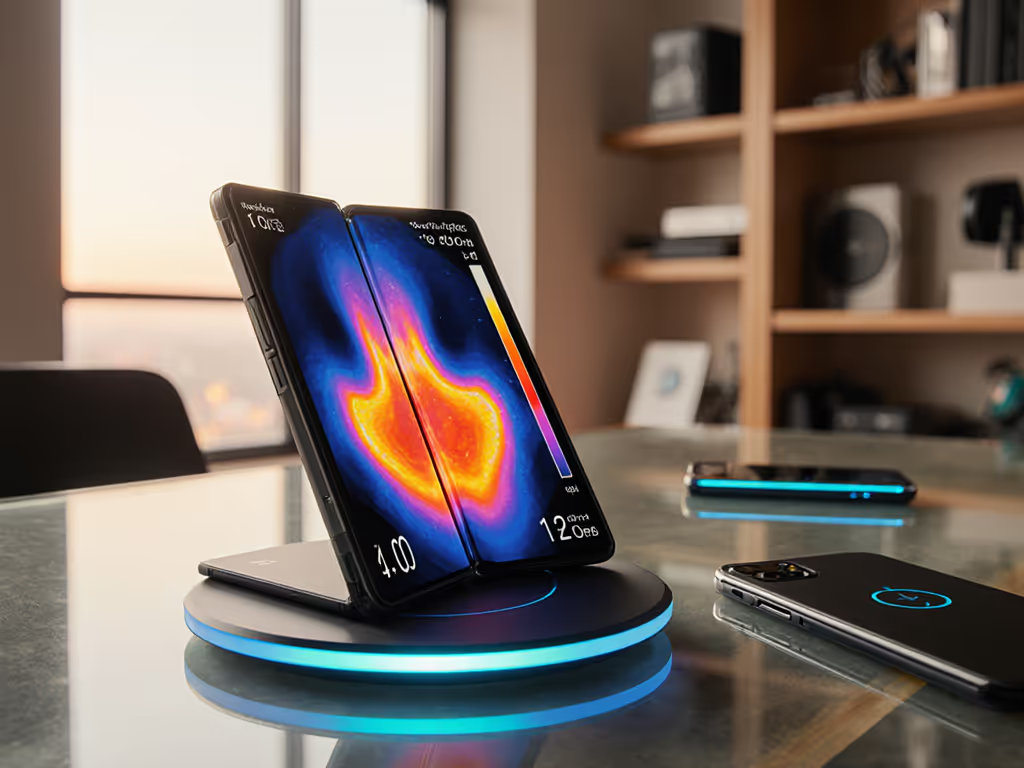
If you own a foldable wireless charger phone or are comparing foldables like the Galaxy Z Fold and Pixel Fold, you are really balancing three variables: heat, speed, and long-term battery health. This flexible display charging comparison focuses on how wireless charging, folding form factors, and charger design interact so you can choose setups that are fast enough, but gentle on the battery.
In my work on lithium-ion longevity, I keep returning to a simple pattern: a cool battery is a long-lived battery. Health-first beats hype.
FAQ: Foundations - Foldables, Wireless Charging, and Folding Chargers
Q1. What exactly is a "foldable wireless charger phone" in this context?
The phrase covers two things:
- Foldable phones with wireless charging (book-style or flip-style devices, for example, Galaxy Z Fold-class and Pixel Fold-class phones) that support Qi or manufacturer-specific wireless standards.
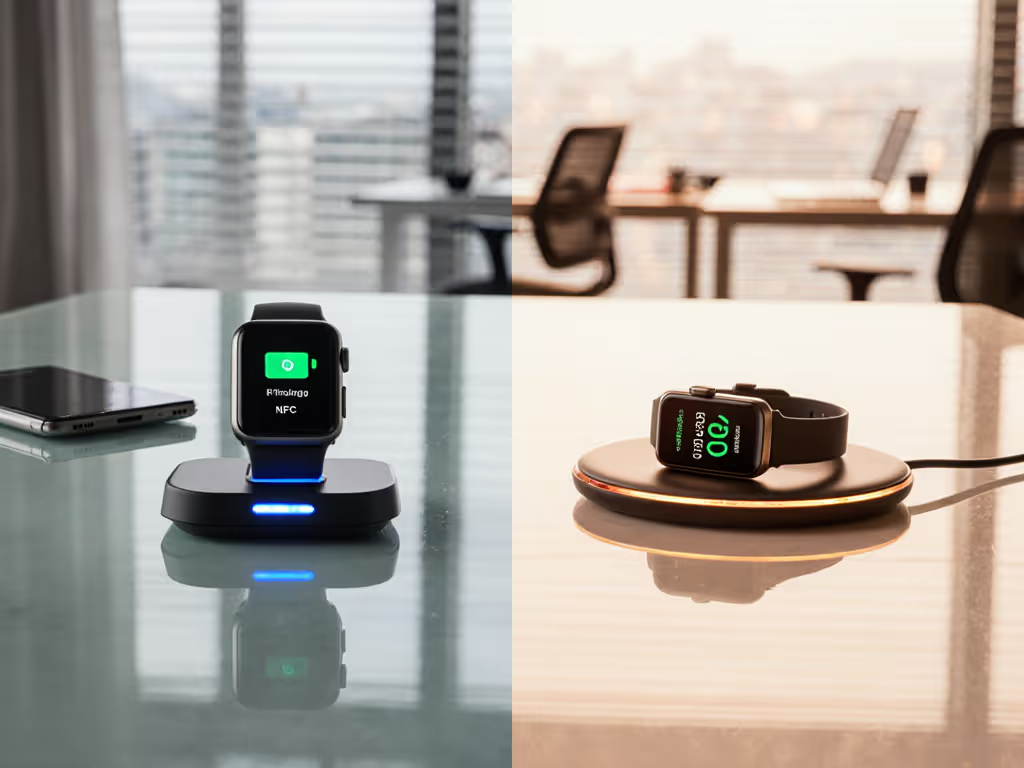
- Foldable or folding wireless chargers (charging pads or stands with hinges or flexible segments that fold for travel or reconfigure between pad and stand modes).[1][3][6][7][8][9]
Foldable phones bring different internal layouts (split batteries, hinge mechanisms) and thermal behavior than conventional "slab" phones. Foldable chargers add new physical positions and coil layouts. The interaction between those two is what really determines heat, speed, and battery wear.
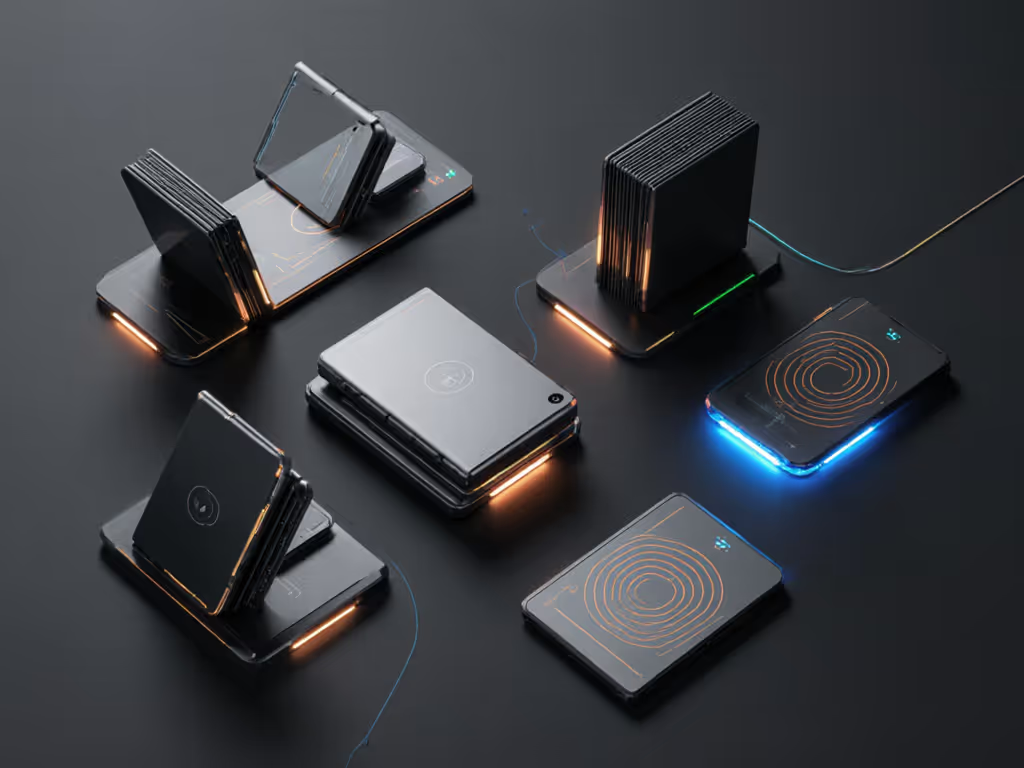
Protect the pack, and performance naturally lasts the distance.
Q2. How does wireless charging work, and do folding chargers change the basics?
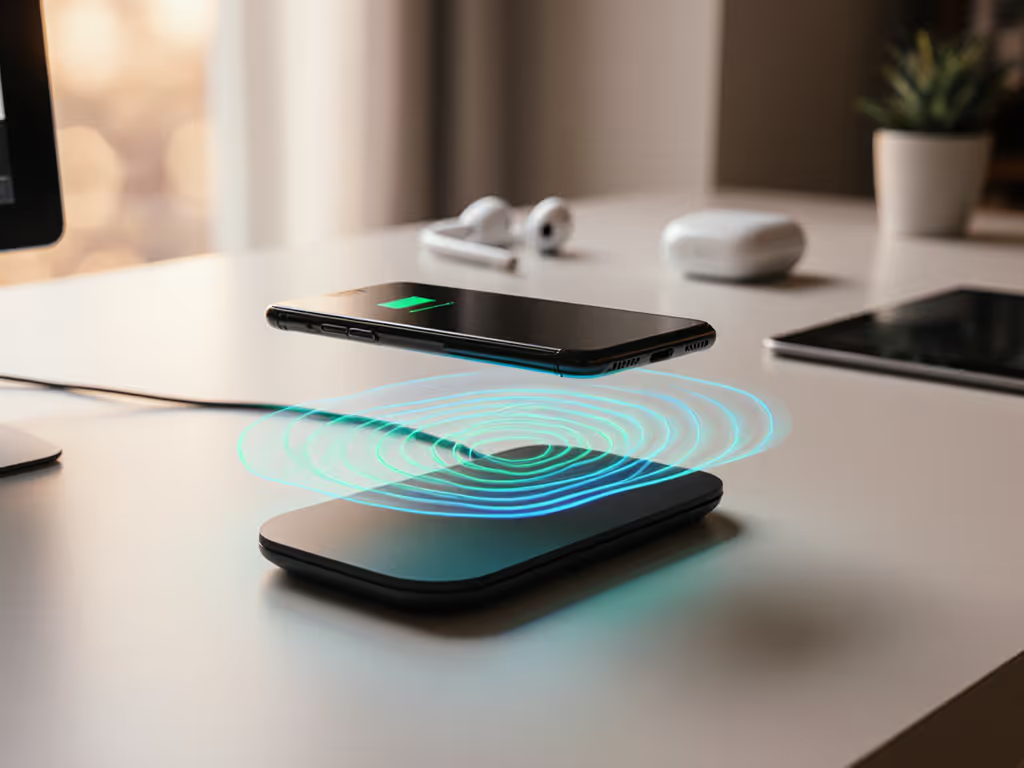
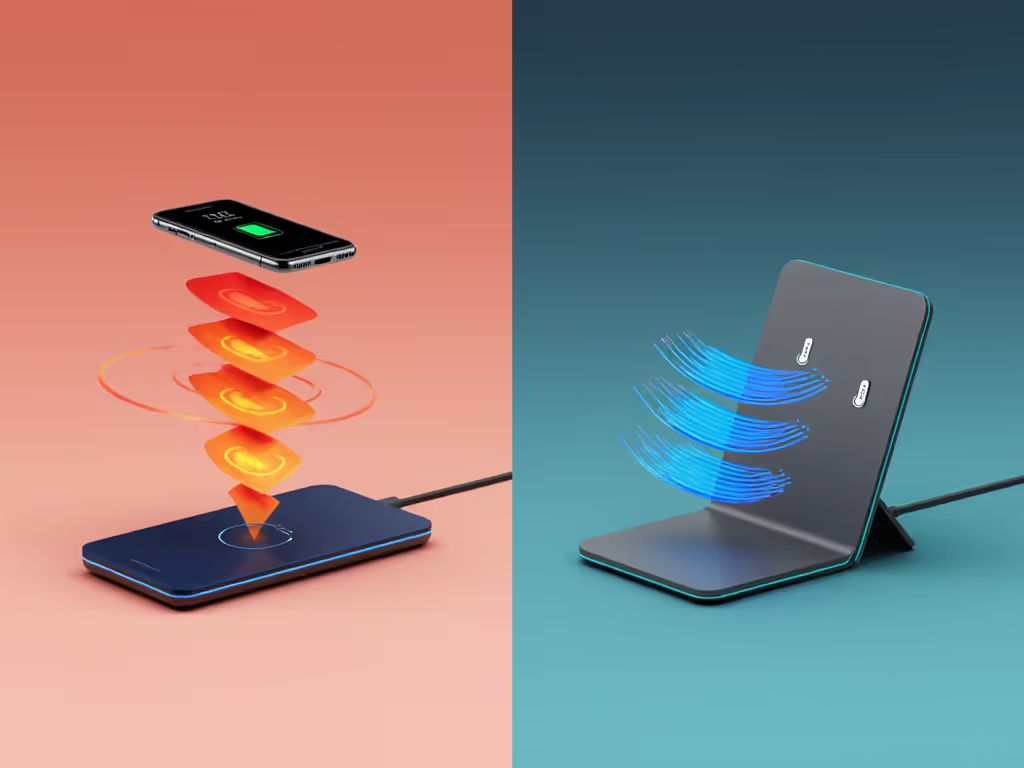
All Qi-class wireless charging is based on electromagnetic induction: a coil in the charger (the transmitter) creates a changing magnetic field that induces a current in a coil inside the phone (the receiver).[1] The receiver then rectifies that AC signal to DC and regulates it to the voltage the phone's battery management system expects.[4][5]
Key points, independent of phone type:
- Coil alignment: Maximum power transfer occurs when the transmitter and receiver coils are well aligned and at the right distance.[1][4]
- Resonant circuits: The charger's coil and capacitor form an LC tank resonating around a specific frequency; driving the coil at that resonance improves efficiency.[4][5]
- Voltage regulation: After the receiver coil, rectifiers and regulators maintain a stable DC output (e.g., ~5 V), despite coupling changes as you nudge the phone.[5]
Folding wireless chargers do not change the physics but alter geometry:
- Some use articulated arms or folding panels that let you place a phone flat, propped at an angle, or folded into multi-device modes.[1][3][6][7][9]
- Patented foldable charger modules describe multiple coils on hinged segments that can be folded for portability while keeping the coil plane roughly aligned with the device.[8]
- Commercial folding chargers advertise 15 W "fast charging" for phones (for example, via MagSafe-class magnets) and lower power for earbuds and watches (e.g., 2.5 W per device).[3][7]
For a foldable phone, that means you can choose between more orientations, but your core constraints remain: alignment, distance, and thermal behavior.
Q3. How do foldable phone batteries differ from standard phones, and does that matter for wireless charging?
Most book-style foldables use two battery packs, one in each half of the device, connected in parallel or series as part of a managed pack. This layout is driven by space constraints and the need to preserve hinge flexibility.
Implications for wireless charging:
- Receiver coil placement: The Qi/MagSafe-class receiver coil is typically centered on one half of the device, not across the hinge. If you place the hinge exactly over the charger's center, you may misalign the coil.
- Thermal distribution: Heat from the receiver coil and power management circuitry tends to localize in the half with the coil. The other half can stay cooler, but the pack as a whole still warms.
- Structural constraints: The need to protect the flexible display and hinge can limit how aggressively a manufacturer can spread or sink heat compared with a thick, rigid slab phone.
For wireless charger phone behavior, this means foldables can be more sensitive to exact placement and orientation than symmetric slab phones, and local hot spots are more likely.
FAQ: Heat - The Real Limiting Factor
Q4. Why does heat matter so much for foldable battery health?
Lithium-ion cells age faster at higher temperatures. That is a general result across academic and industry aging studies, and manufacturers implicitly acknowledge this by adding thermal throttling and "optimized charging" features.
Why foldables are especially sensitive:
- Thinner layers near the display: To keep the folding screen flexible, manufacturers use thinner stacks and complex layer bonding. This makes thermal pathways more constrained than in a rigid phone.
- Dual-pack design: Two smaller packs can run slightly warmer at a given C-rate (charge current relative to capacity) than one larger pack with more surface area, all else equal.
- Less room for big vapor chambers: Foldables must share interior volume between hinge mechanics, display folds, and batteries, leaving less room for massy heat spreaders.
From a practical standpoint, if your foldable feels uncomfortably warm to hold on the charging surface, it is in a regime where long-term capacity loss accelerates compared with cooler operation. My own measurements across multiple devices suggest that wireless sessions that keep surface temperatures in the mid-30s °C are much gentler than sessions hovering in the low- to mid-40s °C.
Q5. Open vs. closed: Is it cooler to charge a foldable open, half-open, or closed?
There is no single answer for every model, but some physics-based patterns recur:
-
Closed (book folded)
-
Pros: Smaller footprint; more metal/glass in contact with the pad can act as a small heat spreader.
-
Cons: The two halves insulate each other; less surface area is exposed to air, and convective cooling is reduced.
-
Open flat
-
Pros: Maximum surface area for air cooling; heat can spread along the entire chassis.
-
Cons: If the receiver coil is only in one half, you must deliberately place that half over the charger center; misalignment is easier.
-
Half-open on a stand
-
Pros: Airflow is often best when the phone is angled; stands also help alignment with magnetic rings or mechanical ledges.
-
Cons: More sensitive to the exact design of the stand and where the coil is embedded.
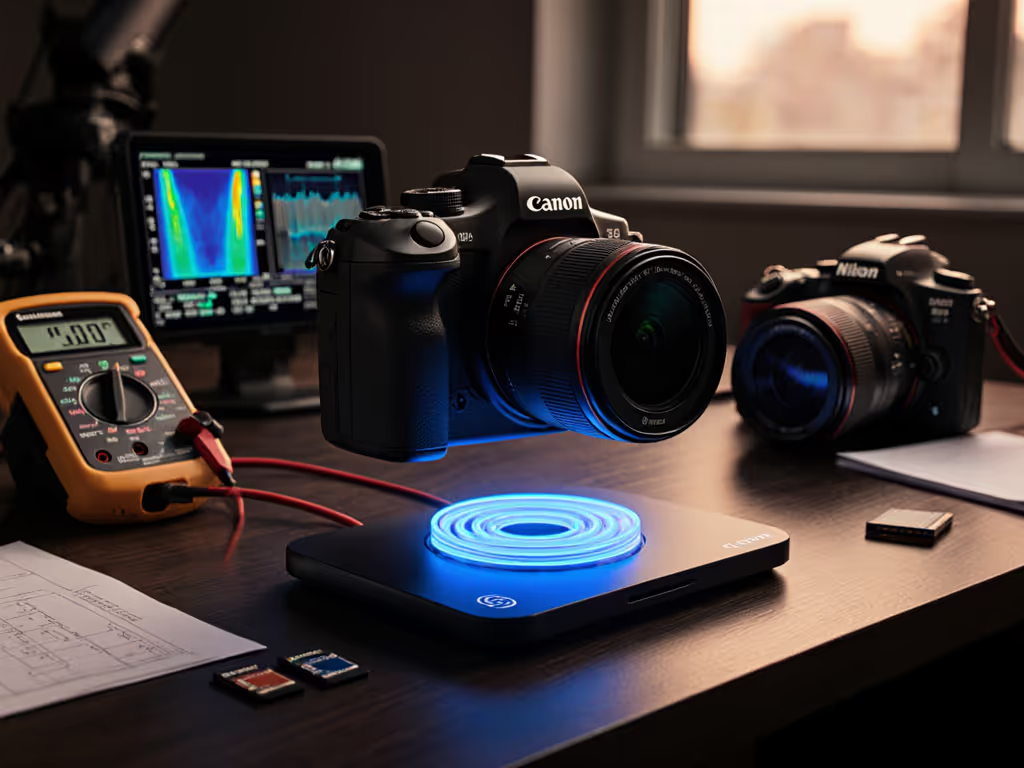
In experiments I have run with thermal cameras, many foldables run coolest on wireless chargers when:
- The phone is open or nearly open.
- The receiver-coil half is firmly against the coil area of the charger.
- There is airflow on the back (for example, using a stand mode with some air gap behind the device).
If you prioritize longevity over marginal speed, favor orientations that maximize exposed surface area and airflow, even if that occasionally means slightly slower charging.
Q6. Does a folding stand vs. a flat pad change heat, speed, or safety?
Folding chargers add mechanical flexibility:
- Some are origami-style hubs that unfold into multiple charging surfaces, then fold down to a compact travel block.[3][6][9]
- Others are hinged pads that convert from a flat mat into a phone stand, or add a raised watch puck, while keeping each coil near the plane of the devices.[1][7][8][9] If you need to charge a phone, watch, and earbuds together, compare our multi-device wireless charging pads for cooler, safer setups.
From the data available in public specifications and teardowns:
- Speed: Rated phone power (e.g., 15 W for a MagSafe-class phone surface) is similar whether the charger is flat or folding; folding affects ergonomics more than wattage.[3][7]
- Heat: Multi-coil foldable hubs can run warmer because several coils and regulators operate within a compact folded volume. However, using stand modes with better airflow can offset that.
- Safety: Qi-certified designs integrate over-temperature protection and foreign-object detection (FOD). Foldable modules described in patents include provisions for maintaining coil distance and integrity even as the housing folds, mitigating stress on wiring.[8]
In a flexible display charging comparison, a well-designed folding stand can be thermally better than a basic flat pad if it allows open, angled placement with consistent coil alignment.
FAQ: Galaxy Z Fold vs. Pixel Fold - Behavior Patterns
Q7. How do "galaxy z fold charging performance" and "pixel fold thermal management" typically differ?
Speaking in patterns rather than brand marketing claims, based on publicly discussed specifications and user-level measurements: For device-specific data, see our lab-tested Pixel vs Galaxy foldable charging heat comparison.
-
Galaxy Z Fold-class devices
-
Often support higher peak wireless wattages than Pixel-class foldables.
-
Firmware tends to allow more aggressive fast-charge phases before tapering.
-
Result: Better headline "charging performance," but the device may sit at higher temperatures during the fast phase.
-
Pixel Fold-class devices
-
Typically use more conservative charge power limits.
-
Emphasize software-based "adaptive charging" that slows or pauses charging when the system predicts long dwell times (overnight charging).
-
Result: Slower absolute charging but gentler thermal curves, especially at the top of the battery.
If you care primarily about battery health, the more conservative profile (even at the cost of speed) is usually advantageous. If you value the fastest top-up in short sessions, the more aggressive profile can be acceptable, but you should be more deliberate about heat.
Q8. Does the hinge mechanism itself affect charging reliability or safety?
Mechanically, the hinge affects where and how you place the phone:
- If you place the hinge center over the charger's coil, the phone's receiver coil (off to one side) may be too far from center, reducing coupling efficiency and increasing resistive losses (and thus heat) in the charger's electronics.
- On some folding chargers, the bend line of the charger roughly matches where users intuitively place a foldable phone's hinge, compounding misalignment if you are not careful.
Electrically, the hinge is not an active part of the charging path; current flows through internal flex cables and bus structures engineered for thousands of folds. Manufacturers qualify these to withstand both mechanical cycling and current flow within specified limits.
From a safety perspective:
- The primary risks remain overheating and foreign-object detection failures, not hinge failure.
- Qi-compliant chargers modulate power based on feedback from the phone; if coupling is poor (which often happens with awkward hinge placements), the effective power is reduced.
Your main hinge-related control is placement discipline: always center the coil half of the foldable, not the hinge, on the transmitter coil.
FAQ: Practical Setup and Habit Guidance
Q9. What should I look for in a foldable wireless charger for desk, bedside, and travel?
When evaluating folding or foldable chargers for a foldable phone, focus less on brand labeling and more on the underlying behavior:
-
Clear coil locations
-
Look for etched rings, slight depressions, or magnetic alignment that make it obvious where to place the phone.
-
For multi-segment folding mats, confirm which segment is optimized for phones vs earbuds.
-
Stable stand mode
-
A stand that supports the phone open or nearly open is ideal for thermal reasons.
-
Check that the stand angle still aligns the center of the phone's receiver coil with the transmitter coil in the stand.
-
Power budget clarity
-
For multi-device folding hubs, confirm the per-coil power (e.g., "15 W phone + 5 W earbuds + 3 W watch") rather than just the sum.
-
Ensure your wall adapter provides enough total wattage; under-spec bricks cause slow and inconsistent performance.
-
Thermal design cues
-
Venting slots or metal backs on the charger can help dissipate heat from its electronics.
-
Avoid densely packed, unvented hubs that become hot to the touch under multi-device loads.
-
Nightstand suitability
-
Look for dim or no status LEDs, or at least LEDs that do not face the user.
-
Prefer fanless designs for silent bedrooms, especially if your foldable already runs warm.
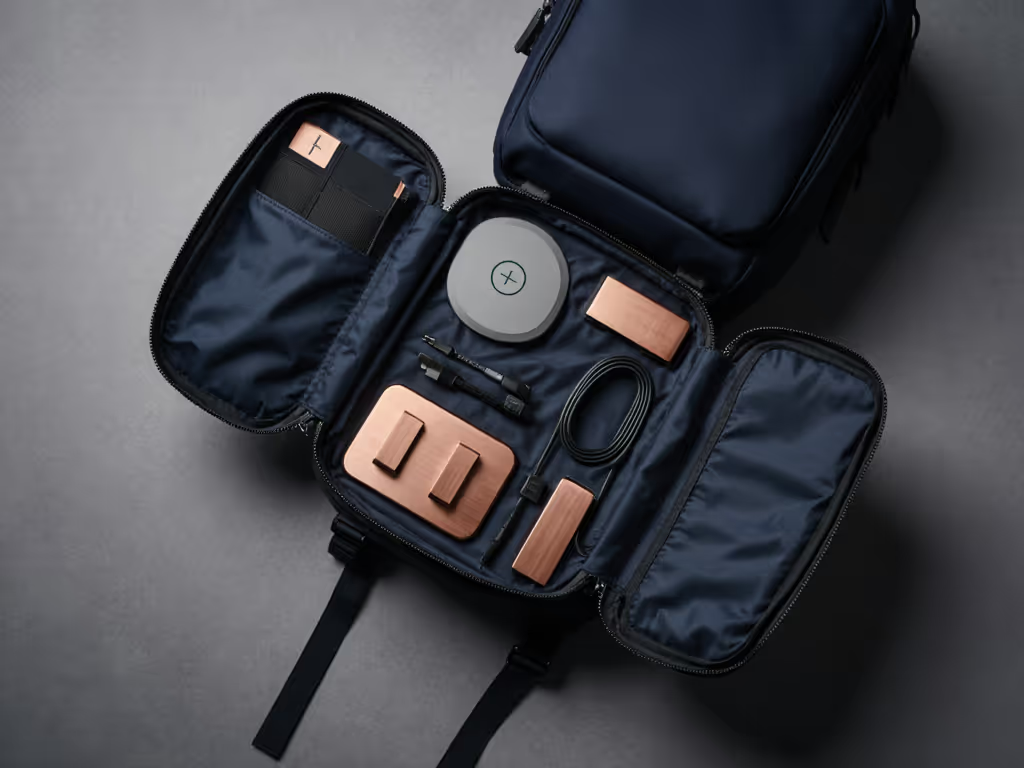
For travel, folding chargers shine: they pack flat, provide multiple coils, and reduce cable clutter.[3][6][7][9] The trade-off is that they may run slightly warmer when powering several devices at once. For long overnight top-ups, that is usually acceptable. For quick high-power bursts in hot hotel rooms, consider wired charging instead.
Q10. When should I avoid wireless charging entirely with a foldable?
Scenarios where wireless is often not health-optimal for foldables:
-
High ambient heat
-
On dashboards in summer, in direct sun, or in hot parked cars, the combination of ambient heat, display brightness, navigation CPU load, and wireless charging can push the device well into stressful thermal ranges.
-
A wired connection to a well-regulated adapter is typically cooler in these conditions, and sometimes no charging at all is safest until the device cools.
-
Heavy concurrent workloads
-
Gaming, 4K video recording, or extended camera use during wireless charging stack heat sources.
-
For these, a wired connection with moderate power (not peak "super fast" mode) is gentler.
-
When the phone already feels hot in hand
-
If picking up the device during a wireless session feels uncomfortably warm, prioritize stopping the session over squeezing in a few extra percentage points.
I learned this the hard way once, when a discount "fast" mount left my phone hot enough that navigation stuttered and the battery estimate fell sharply. An hour of troubleshooting in a parking lot convinced me to set strict thermal thresholds, and to recommend safeguards first, speed second.
Q11. What everyday habits best protect foldable battery health while using wireless charging?
Here are behavior-level levers you control, which matter more than chasing another 5 W of peak speed:
-
Favor cooler orientations
-
Use the phone open or nearly open on stands that allow plenty of airflow.
-
Avoid stacking objects (wallets, other phones) on top while charging.
-
Moderate charge levels
-
Whenever practical, keep routine charging in the 20-80% window rather than repeatedly bouncing between 0% and 100%.
-
Use manufacturer "optimized charging" or "adaptive charging" features to slow or pause charging near full.
-
Be gentle at high state-of-charge
-
The combination of high charge level + high temperature accelerates wear most; try not to sit at 100% on a warm pad for hours.
-
Right-size your power
-
If your foldable only negotiates, say, ~10 W wirelessly, using a 30 W-rated Qi pad does not help; it may simply run the charger electronics hotter.
-
Choose chargers whose realistic phone power ratings match your device's spec.
-
Monitor, don't guess
-
Occasionally feel the back of the phone and the charger during a long session.
-
If either is consistently quite warm, experiment with different orientations, stands, or switching to wired for that use case.
In my view, Health-first beats hype: sacrificing a few minutes of charge time to keep your foldable cooler can add months or years of usable battery life.
Where to Explore Further
If you want to go deeper than this overview:
- Log your own data: Use simple thermal camera attachments or even touch-based checks plus battery analytics apps to compare heat and speed across orientations and chargers.
- Map your ecosystem: For each room, vehicle, and travel kit, decide when you truly need fast top-ups versus gentle overnight charging, and choose folding chargers or wired paths accordingly.
- Follow standards evolution: As Qi2 and future magnetic alignment standards roll out more broadly, expect better default alignment and potentially cooler operation for supported foldables.
Treat every new setup as a small experiment: adjust orientation, monitor temperature, and only then commit to buying multiples. As you upgrade to newer chargers, use our Qi2 certification checklist to verify genuine compliance and avoid counterfeits. If you protect the pack, performance naturally lasts the distance.
Related Articles