Dynamic Frequency Adaptation: Wireless Charging Explained
By Mira Chen • 10th May
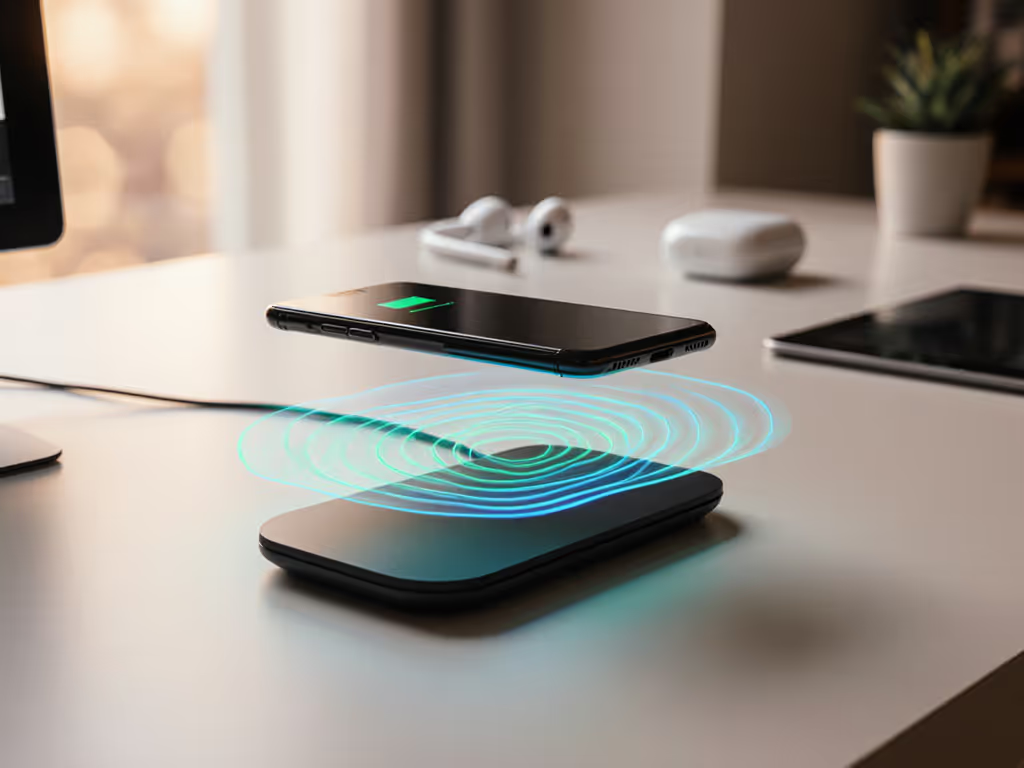
Dynamic frequency adaptation wireless charging and resonant auto-adjusting rectifier technology represent the evolution of how modern pads optimize power delivery in real time. Rather than feeding fixed-frequency signals to your device, adaptive systems tune themselves (second by second) to match electrical conditions, coil geometry, and thermal states. This matters not because it chases headline watts, but because it preserves the sustained throughput your battery actually needs while keeping temps in a safe envelope.
The Qi2 standard and modern MagSafe implementations lean heavily on this principle. If you're choosing between platforms, our MagSafe vs Qi guide explains alignment, speed, and accessory trade-offs. Understanding how and why it works explains why advertised peak rates often mean very little, and why watching the boring metrics (stable 15- and 30-minute charge curves under load) reveals which pads and stands will age your devices or keep them healthy.
FAQ Deep Dive
Q: What is dynamic frequency adaptation, and why does it matter more than raw wattage?
A: Dynamic frequency adaptation is the charger pad's continuous adjustment of electromagnetic frequency to match the receiver coil's impedance and thermal state. Fixed-frequency pads broadcast the same signal regardless of alignment, case thickness, or heat (like trying to maintain one volume level in a crowded room). Adaptive systems listen and respond.
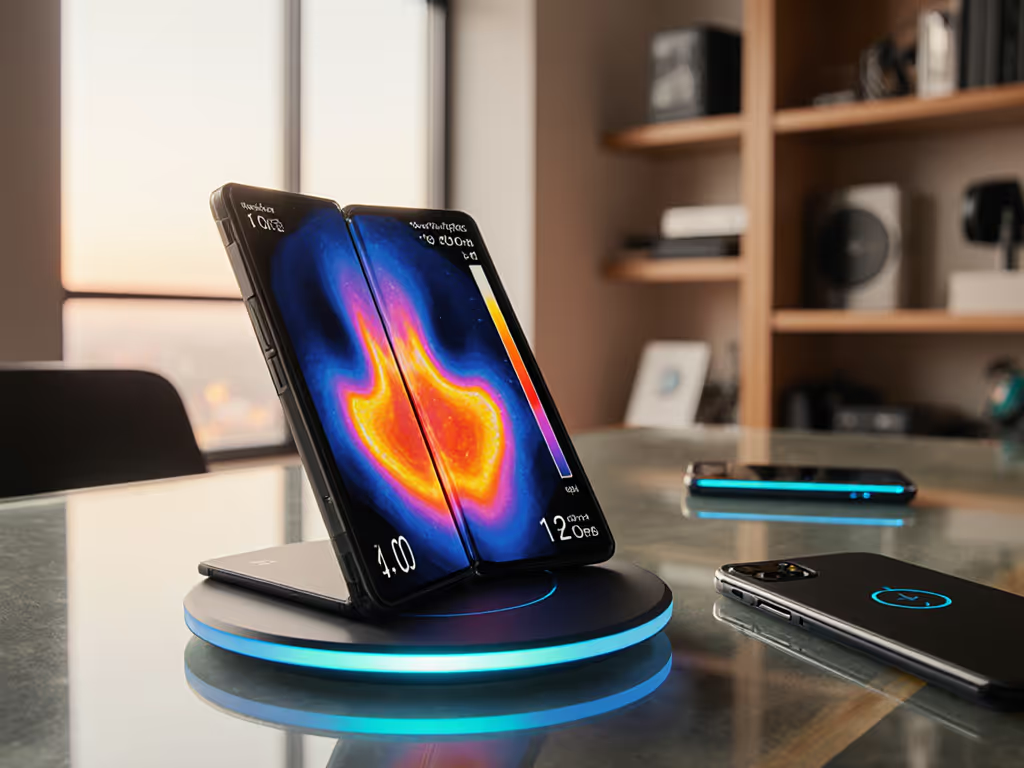
Here's the practical layer: a pad broadcasting 40 W at startup might spike your phone to 45°C within 5 to 8 minutes, triggering the device's thermal throttle. Suddenly, you're charging at 18 W. That's what happened during a midnight test cycle (one well-known pad advertised 40 W), and the thermal imaging bloomed red within minutes. The coils had no feedback loop; the brick just dumped power. By the 30-minute mark, sustained average hovered around 20 W. For lab-verified throttling curves across major brands, see our wireless charging speed test.
A properly implemented adaptive system, by contrast, starts at a lower frequency envelope, reads coil efficiency in real time, and scales up only as long as device and pad temps remain stable. The result: sustained 30-35 W over 30 minutes at 22°C ambient, with the phone never exceeding 38°C.
Speed means nothing without controlled heat and repeatable data.
That's the rule that changed how I evaluate every pad now.
Q: How does a resonant auto-adjusting rectifier keep efficiency high without creating heat?
A: A rectifier converts AC energy at the coil into DC for the battery. In fixed systems, the rectifier works at one efficiency point. Mismatch the frequency, phase angle, or load impedance, and efficiency tanks, so excess energy bleeds as heat.
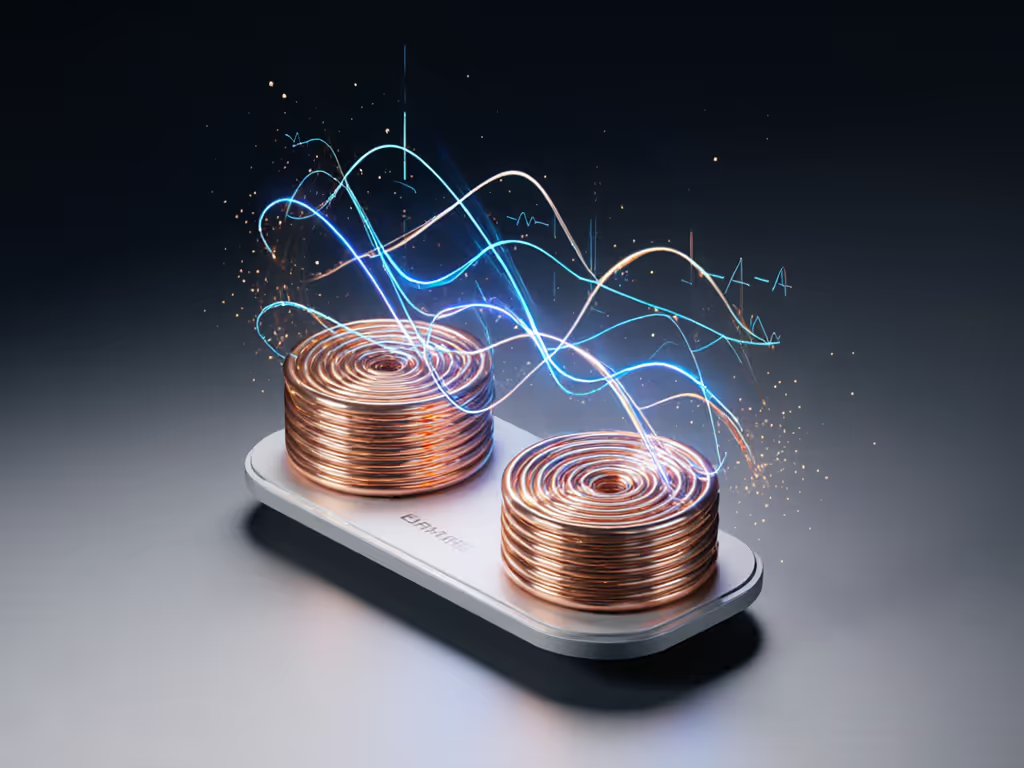
A resonant auto-adjusting rectifier (part of the receiver-side circuit) continuously optimizes the load impedance seen by the transmitter coil. When coil-to-coil coupling weakens (say, you're charging through a 3 mm thick case, or the phone shifts slightly), the rectifier adjusts its input impedance to keep the transmitter's frequency and voltage aligned to the peak efficiency point.
The math is straightforward: if fixed-frequency coupling efficiency drops from 92% to 78% due to case thickness, that 14-point swing means 14% of input energy becomes waste heat. Over 30 minutes of 40 W input, that's roughly 25-30 kJ of extra thermal load. A real-time charging efficiency system keeps efficiency in the 85-90% range across a wider span of misalignments.
Thermals decide winners here.
Pad efficiency directly correlates to device temp, which determines throttle behavior and battery cycle wear.
Q: Why do manufacturers advertise high peak watts if sustained rates are lower?
A: Marketing incentive. A pad that sustains 25 W at safe temps looks less impressive on a spec sheet than "40 W Fast Charge" in bold letters. Peak watts are real. They happen in the first 2-5 minutes, often at 22°C ambient, with zero case, on a brand-new coil alignment.
But peak performance rarely matches user reality. Most people:
- Charge overnight (ambient temps drop; device cools; dock sits passively for 8 hours; no throttle needed anyway).
- Charge in offices, cars, or kitchens at 24-28°C.
- Use a case (which adds thermal resistance and coil distance).
- Charge a warm device (post-use, running background tasks).
Under these conditions, realistic sustained throughput is often 40-60% of the advertised peak. A 40 W pad might deliver 22 W sustained; a 25 W certified pad might hold 20 W sustained. The certified one doesn't look appealing, but if it stays below 37°C for 30 minutes and the other climbs to 42°C by minute 12, the certified pad will deliver more full cycles before battery capacity fades.
Q: How does wireless power optimization through adaptive frequency tuning extend battery life?
A: Battery longevity follows a curve: every 5°C increase in operating temperature roughly doubles the rate of calendar aging. A phone charging at 37°C instead of 42°C sees meaningful reduction in capacity fade over 18-24 months.
Adaptive frequency tuning also enables the charger to stay sensitive to the device's thermal feedback. Many modern phones (iOS 18+, Android 15+) send thermal packets to the pad, signaling when to back off. A smart pad responds by:
- Lowering frequency, which reduces coil losses.
- Requesting that the power brick dial down output.
- Holding steady rather than trying to chase peak watts.
Result: the device stays cooler, never triggers deep throttle, and cycles age more gracefully. Over 500 full-depth cycles, this difference compounds, and a device that charged 2°C cooler on average might retain 92% capacity instead of 87%.
This is why tracking 15 and 30-minute sustained averages (not peak rates) gives you the clearest picture of what a charger will do to your battery over time. For the underlying physics of heat, safety, and induction, read our science behind wireless charging.
Q: Does case thickness or magnet strength affect frequency adaptation?
A: Yes, significantly. Thicker cases increase coil-to-coil distance, which lowers coupling coefficient and shifts the optimal frequency window. A proper adaptive system detects this shift and re-tunes. A poor one doesn't.
Test example: same pad, tested with:
- No case.
- 1.2 mm Apple silicone case.
- 2.8 mm third-party rugged case.
With a fixed-frequency pad, sustained charge rate might drop from 28 W (no case) to 22 W (silicone) to 16 W (rugged). An adaptive pad might drop to 25 W and 21 W (a much narrower variance because frequency and phase shift to compensate).
Magnet strength (measured in Gauss or Tesla) also factors in. Weaker magnets mean looser alignment tolerance, which means more geometric variance during a charge session. The frequency adaptation must correct for this drift continuously.
When testing, always document:
- Case type and thickness (in mm).
- Magnet field strength (if specified).
- Test distance from coil center (measure with calipers; most labs use coil-to-phone-back distance).
- Ambient temperature and humidity.
- Initial device temp at start.
- Firmware/OS versions of device and pad controller (if applicable).
These variables are why one lab's "25 W sustained" might differ from another's if test protocol isn't identical.
Q: Will dynamic frequency adaptation make older non-Qi2 devices obsolete?
A: Not overnight, but the ecosystem is clearly consolidating toward Qi2 and MagSafe. Older Qi (WPC Qi 1.2/1.3) devices have fixed-frequency receivers, so they can't exploit adaptation. However, they'll still charge on adaptive pads (the pad simply adapts to the older device's fixed impedance profile).
What will happen: new devices will ship with adaptive receivers, and new pads will be tuned for those. Backward compatibility will persist for 3-5 years (as it has with all wireless standards), but premium features (fast sustained charging, thermal feedback, real-time charging efficiency) will be reserved for Qi2-certified or MagSafe-compatible hardware.
The practical upshot: if you're buying a charger today, prioritizing Qi2 certification means your investment will gracefully extend to the next two to three device cycles without a total refresh.
Summary and Final Verdict
Dynamic frequency adaptation and resonant charging technology solve a real problem: the gap between advertised peak watts and useful sustained performance. By tuning coil frequency in real time, adaptive systems keep power delivery steady, thermals controlled, and battery wear minimal.
The key takeaway mirrors what matters most to your device's long-term health: sustained, cool watts beat brief peaks. When evaluating a charger, ignore the 40 W splash and request the 30-minute sustained rate at 25°C ambient, with case attached, and starting device temp at 30°C. If a pad can hold 28 W for 30 minutes and stay below 38°C under those conditions, you've found a keeper. If it throttles to half-speed by minute 12, it will age your battery faster than a lower-peak pad that maintains steady, cool throughput.
Invest in adaptive systems certified for Qi2 or MagSafe, verify sustained rates via lab data or user reports, and your overnight-charging dock and desk stand will compound into years of reliable, healthy device cycles instead of a year and a half of capacity fade. Thermals decide winners here.
Related Articles